Why Utah Wild Goji?
.jpg/:/)

%20(1).PNG/:/)

.jpg/:/)



Researches
Astrobiological Assessment of Utah Goji for Bioregenerative Life Support Systems in Closed-Loop Space Habitats 2026
Development of a Functional Jelly-Based Snack Using Goji Berries 2025
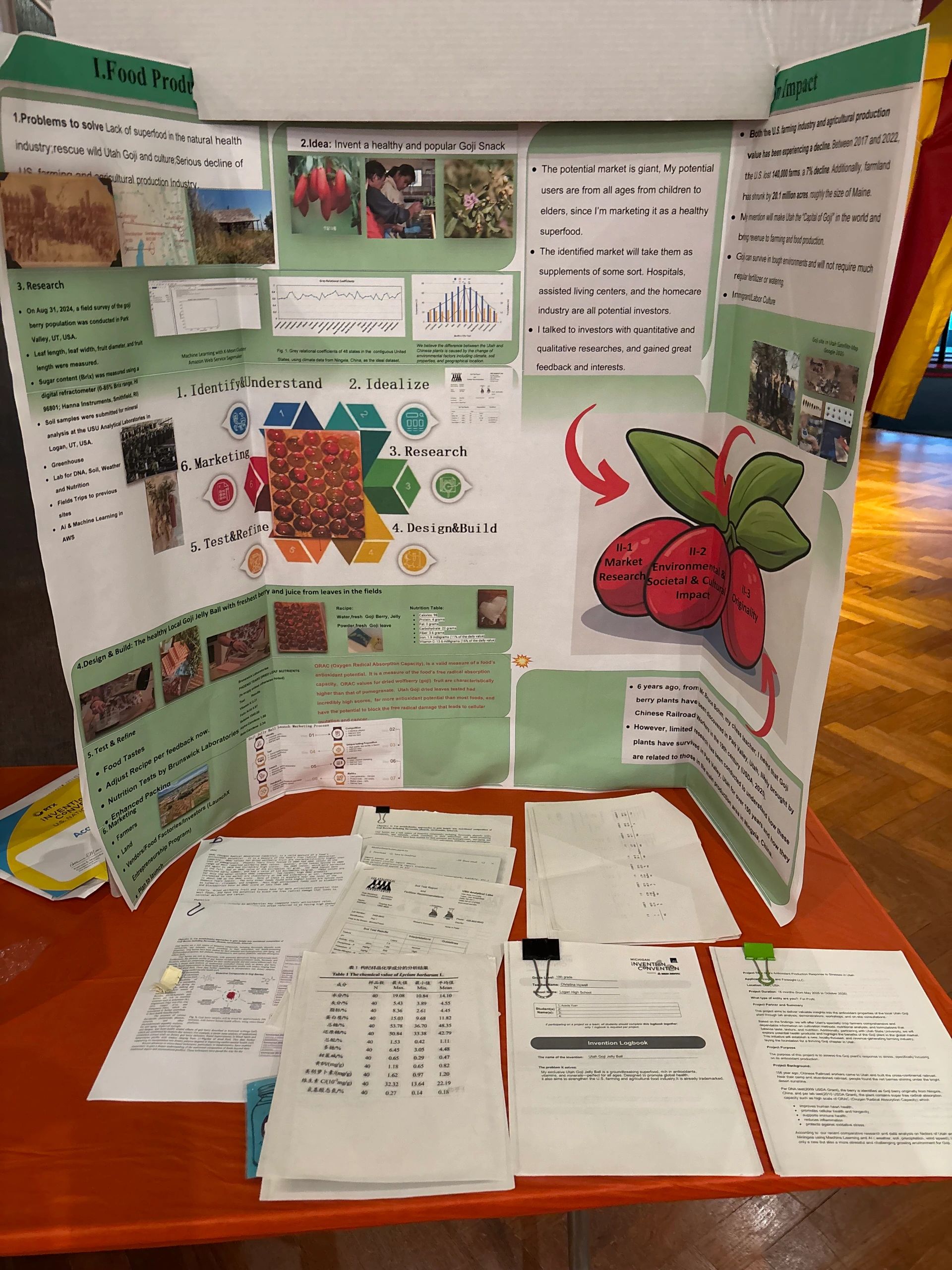
Utah Goji (Lycium) Jelly Ball -RTX Invention Convention US. Nationals 2025
Comparative Analysis of Lycium barbarum in Ningxia, China and Utah, USA 2025
Professional Profile Tests
DNA Tests
have been identified as Lycium Barbarum. This was accomplished by comparing the DNA of our plants with the DNA of wolfberry plants grown from seed obtained from Ningxia, China. Biogenetic Services, Inc. identified only one genetic marker in 1000 that was different in the two plant varieties. They are not only the same genus-species, but also are very similar varieties. (Thanks to Phoenix Tears Nursery)
Third Item
22
Add a description about this item
Nutrition Profiles
We don't want to claim Utah Wild Goji as the "Best" Goji title in the wild worlds but record the nutrient values and facts. and suggest some usages.
DRIED LEAF NUTRIENTS (Tested by Brunswick Laboratories with USDA Special Cr
(In mcg/g unless otherwise noted)
Test Results
Vitamin K 2.31
Folic Acid 5.97
Betaine 1540.00
Alpha-Carotene 1.58
Beta-Carotene 2.34
Lycopene 242.00
Zeaxanthin 84.00
Lutein 416.00
Vitamin C 1020.00
Catechin 2.00
Epicatechin 0.20
Epicatechin Gallate 0.10
Catechin Gallate 0.20
Gallocatechin 0.50
Epigallocatechin 0.20
Gallocatechin Gallate 0.10
Epigallocatechin Gallate 0.10
Vitamin B2 9.03
Vitamin B3 21.50
Vitamin B5 6.31
Alpha-tocopherol 567.86
Beta-Tocopherol 4.77
Gamma-tocopherol 12.03
Delta-tocopherol 0.95
Tocotrienol Not detected
ORAC-hydro 522 micromole TE/g
Total Phenolics 30.50 mg/g
Total ellagic acid Below quantifiable levels
Total Bioflavonoids 19.83 mg/g
PQQ (pyrroloquinoline quinone)
Dried leaves and dried fruit were sent to NPA Laboratories to test for PQQ (pyrroloquinoline quinone). The nutrient was not found in the leaves, but the fruit contained 17.9 mcg/g.
ORAC (Oxygen Radical Absorption Capacity)
ORAC (Oxygen Radical Absorption Capacity), is a valid measure of a food’s antioxidant potential. It is a measure of the food’s free radical absorption capacity. ORAC values for dried wolfberry fruit are characteristically higher than that of pomegranate. Phoenix Tears fruit tested in 2009 had ORAC values in the range of most reported wolfberry ORAC values. However, dried leaves tested in 2009 and again in 2010 had incredibly high scores.
The 2009 leaves, which were harvested in the fall, had an ORAC value of 456 micromoles TE/ gram. The 2010 leaves were harvested early summer, and had a value of 522 micromoles TE/gram. These values are for only the water-soluble ORAC component. Two recent, high ORAC products introduced to the market are chokecherry at 160 and elderberry at 147. Pomegranate is about 100 on the ORAC scale. None of these is anywhere near the level of the Phoenix Tears leaves.
The only other foods found with higher scores are spices such as turmeric, cinnamon, and oregano. Most high antioxidant foods such as blueberries and blackberries have an ORAC score of less than 100.Clearly, dried wolfberry fruit and leaves have far more antioxidant potential than most foods, and have the potential to block the free radical damage that leads to cellular mutation and cancer.
Phenolics
The presence of polyphenols in wolfberries may compound their antioxidant roles. Blueberries, red grapes, and green tea are often referred to as having high phenolic content, contributing to their high antioxidant potential. The combination of ORAC, phenolics, and carotenoids in wolfberries, present a very compelling case for obtaining antioxidant action from a single food source. Among common fruit, the highest phenolic contents are found in plums and cherries (28 mg/g).
Phoenix Tears wolfberry leaves tested in 2010 had a total phenolic content of 30.50 mg/g. Wolfberry and green teas have comparable phenolic content, but the wolfberries contain no caffeine.
Ellagic Acid
The presence of polyphenols in wolfberries may compound their antioxidant roles. Blueberries, red grapes, and green tea are often referred to as having high phenolic content, contributing to their high antioxidant potential. The combination of ORAC, phenolics, and carotenoids in wolfberries, present a very compelling case for obtaining antioxidant action from a single food source. Among common fruit, the highest phenolic contents are found in plums and cherries (28 mg/g).
Add a footnote if this applies to your business
This website uses cookies.
We use cookies to analyze website traffic and optimize your website experience. By accepting our use of cookies, your data will be aggregated with all other user data.